
I wanted to take a moment and write about Core Energy™ Coaching. To be honest, I think this is as much for myself as it is for anyone reading this who wants to understand what is meant by the word “energy” in that title. Some may easily align with the word, while others may feel it has no real place in a professional setting. And I get that because that’s how I felt about it too.
What changed for me was gaining a deeper understanding of energy as I went through the Institute for Professional Excellence in Coaching (iPEC) coaching program. It’s not “woo woo” for me anymore. In fact, it has become a lens for me to see life through that leaves me feeling more empowered in my ability to choose and create.
So, with that, let’s get into this.
Firstly, we should probably clarify what coaching is and isn’t. I find a lot of people have a basic understanding of what coaching is and quite often associate it with other professional roles such as a sports coach, therapist, mentor, or consultant, to name a few. While some skills may have crossover in these areas, professional coaching, as defined by the International Coaching Federation (ICF), is a collaborative partnership between coach and client in a thought-provoking, creative process that maximizes the client’s personal and professional potential by unlocking more of their own authentic insights and capabilities.
Simply put, coaching isn’t about giving answers. It is about creating a safe space for people to discover what aligns with who they want to be and choose it.
Secondly, let’s become more familiar with energy and its role in our lives. Energy has commonly been defined as the potential for action, and physicists point out that everything you do requires energy and has an energetic charge (Waldorf, 2018). Psychology attaches energy to consciousness, highlighting a connection not only between your body and brain, but between yourself, others, and the world around you (Siegel, 2017).
Neuroscientists further reinforce this energetic connection by mapping electrochemical energy flow in the brain. What is known is that our electrochemical energy is used to initiate action, and each of our thoughts, emotional responses, and subsequent behaviors also generate a reaction, or energetic consequence (Loehr & Schwartz, 2003). What this means is that we can intentionally change the way we are engaging with our perceived reality so that life presents increased opportunities to learn and grow, resulting in the energetic consequence of life working for us, not against us (Waldorf, 2018).
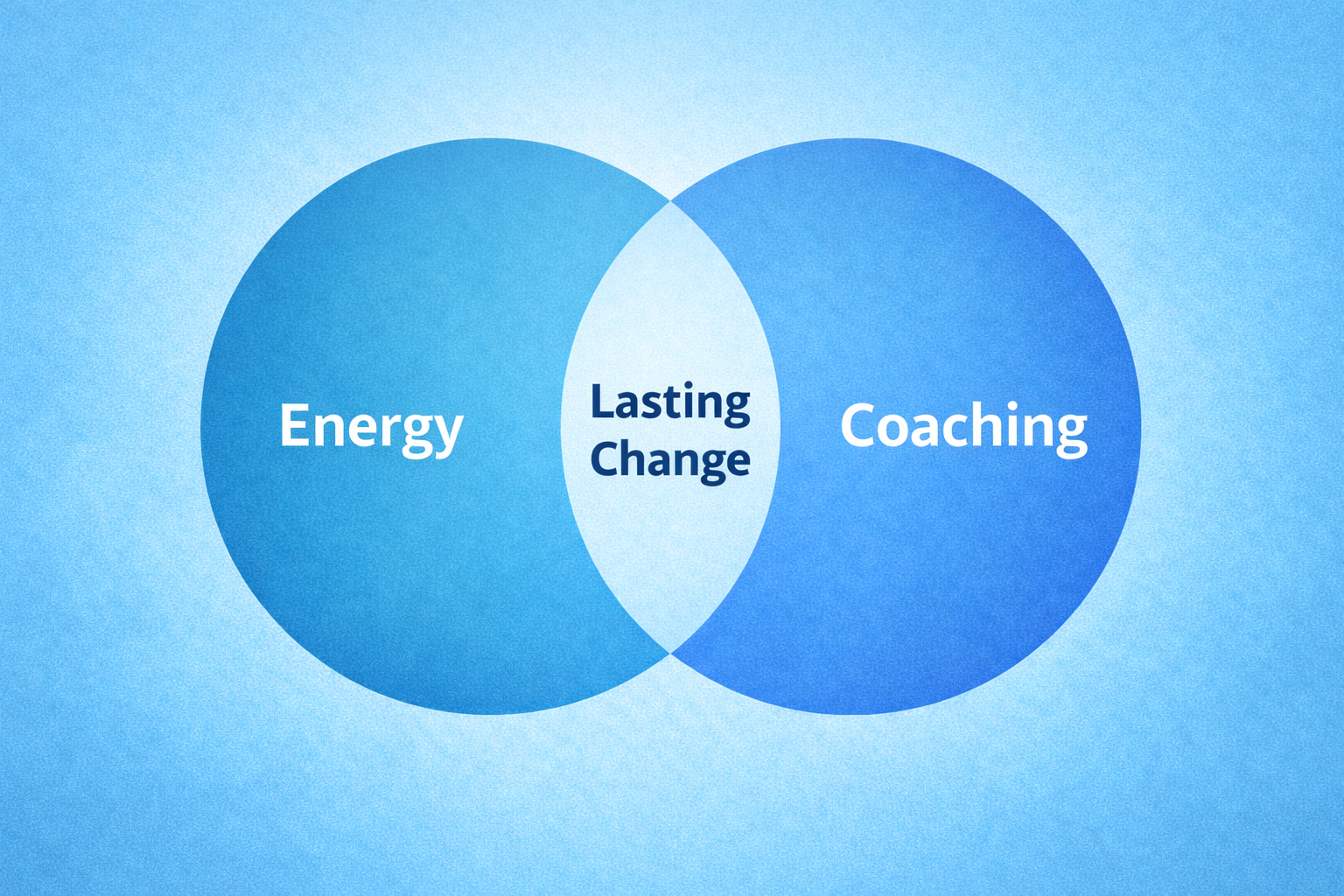
So where does Core Energy Coaching fit in, and where does it begin to differentiate from traditional professional coaching? Well, it is the level of depth we get into.
Core Energy Coaching is based on the two-fold understanding that humans are, at the core, energetic beings and that the quality and amount of core energy a person experiences daily will determine his or her overall potential to pursue goals and experience fulfillment (Waldorf, 2018). Most traditional coaching, which is very empowering coaching I might add, targets behavior and thinking. You will find questions revolve around “What’s your plan?”, “What action(s) will you take?”, “What’s your next step?” for behavior, and “What belief is holding you back?”, “What can you think instead?” for thinking.
Core Energy Coaching goes another layer deeper, getting to your “who” beyond your “what” and “how.” It addresses your engagement, your energy, and your identity. These questions sound more like “Who are you in this moment?” and “Who do you want to be?” for identity, and “What attitude are you bringing?”, “How do you relate to this situation?”, and “What is your emotional state?” for engagement and energy.
The significance of this next layer is that we are not only focused on adjusting strategy. We focus on transforming the source from which strategy is created so change is not temporary, but lasting.
For me, I resonated with iPEC’s approach to coaching. I’ve lived life tying my sense of worth to outcomes and performance and, in doing so, gave away the power I had to determine my value. I always felt “less than.” The idea of working with someone on the identity level hit home because it isn’t that we are trying to work with people to be someone else. We are trying to help them realize that they are enough right now, that their value doesn’t have to be, and frankly isn’t, something that is earned. It is inherent.
I’ve come to know that we are far less limited by the world around us than we are by what we come to believe about ourselves. I also believe that each one of us is a leader. Leading is the way we help move people into action, including ourselves (Waldorf, 2018). How we see ourselves determines our ability to lead others, communicate with others, build relationships with others, and ultimately how satisfied we feel in our lives.
By learning to access and embrace our core identity, we can maximize our effectiveness as leaders in our homes, careers, and communities.
If this resonates, take a moment to notice where it shows up in your life. And if you want to explore it further, I’m always open to a conversation or, at the very least, would love to hear your thoughts in the comments. Thanks for reading.
References
Loehr, J., & Schwartz, T. (2003). The full power of engagement. Simon & Schuster.
Siegel, D. J. (2017). Mind: A journey to the heart of being human. W. W. Norton & Company.
Waldorf, L. (2018). Your core energy determines your life potential. Institute for Professional Excellence in Coaching (iPEC).