
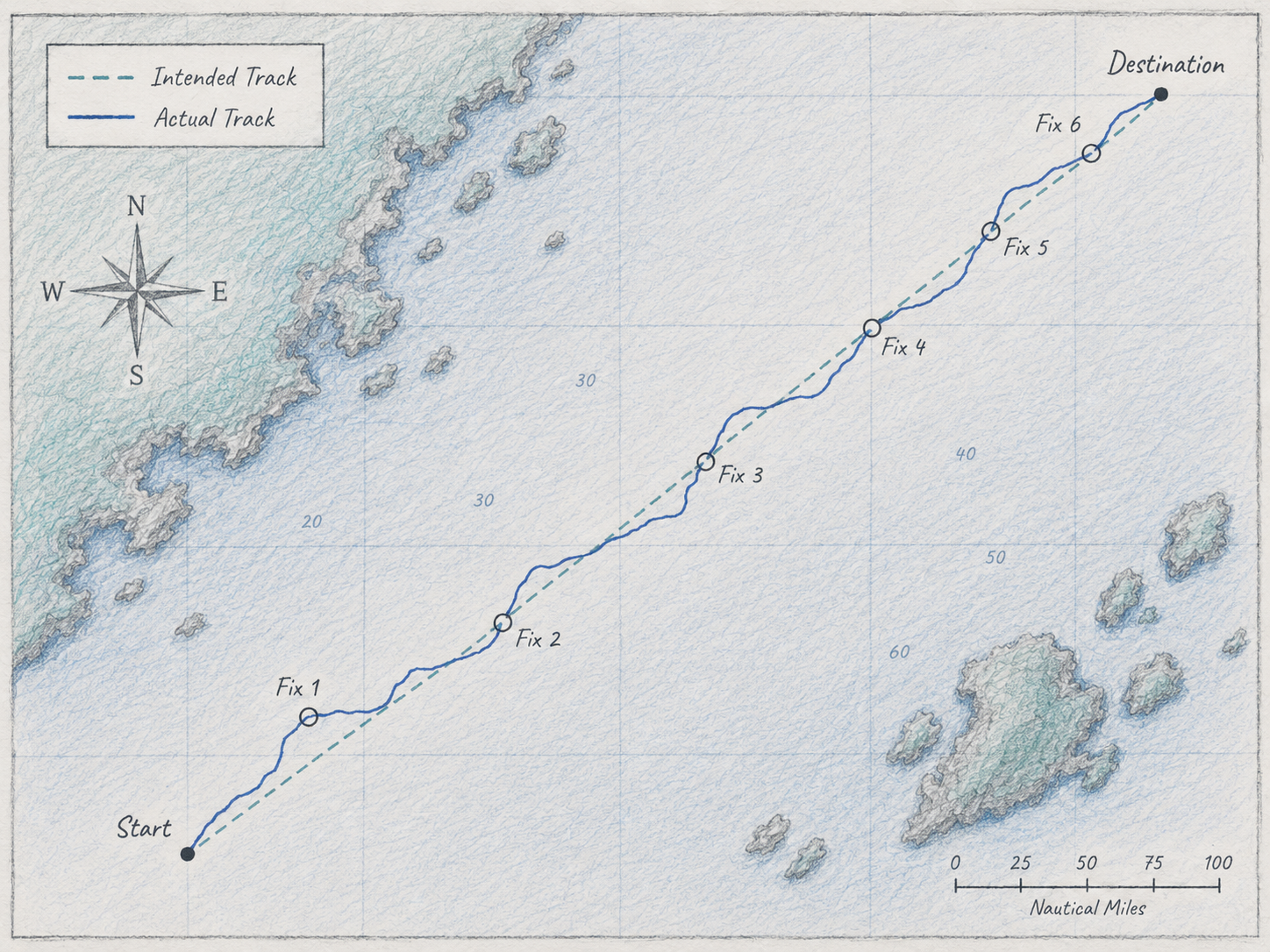
In the first article of this series, I looked at maritime navigation from the perspective of developing other leaders. The main idea was that if we zoom in too closely on someone’s development, their path can look messy, inconsistent, and full of corrections. Zoom out far enough, though, and a much clearer trajectory may appear. This second article turns that same idea inward. What happens when we apply the principles of navigation to our own leadership, our own growth, and the mistakes we make along the way?
I think many of us carry an unrealistic expectation of what progress should look like. We develop a vision, make a plan, choose a direction, and hope that good judgment and hard work will allow us to steadily move toward the destination. Then reality gets involved. Decisions do not always produce what we expected. Circumstances change. New information appears. People surprise us. We surprise ourselves. We make mistakes, reconsider assumptions, and occasionally discover that the direction we were confidently moving in needs to change.
Maritime navigation gives us a more realistic picture. A vessel may have a destination and an intended track, but its actual track over the ground can be far less orderly. Current, weather, changing conditions, new information, and navigational adjustments all influence the journey. Some corrections are small and others are significant. If we plotted every movement closely, the resulting track might look messy. Yet when we zoom out and compare where the vessel began with where it eventually arrived, the larger direction may still be remarkably steady.
Leadership and growth work much the same way.
You Need a Destination Before You Need the Entire Route
Navigation begins with knowing where you are trying to go. Without some sense of destination, course correction becomes difficult because there is nothing meaningful to correct toward. Leadership requires similar clarity. We need some understanding of what matters to us, what we are trying to build, who we are trying to become, or what kind of impact we hope to have. Vision, values, purpose, and goals help provide that orientation.
Where we can get ourselves into trouble is assuming that a clear destination should also give us a clear route. At the beginning of any meaningful pursuit, we are working with the information, experience, resources, relationships, and judgment available to us at that moment. There are things we cannot know yet because we have not encountered them.
Eventually, we have to choose a heading and move. That takes humility. We may later discover that the direction we chose needs adjustment, and admitting that requires us to loosen our grip on an earlier decision. There is also humility in recognizing that the decision may have represented our best effort with what we knew at the time. Moving forward can give us information that remaining still never could.
We do not need the full route before we begin. We need enough clarity to begin navigating.
Your Heading Will Meet Reality
Once a vessel begins moving, its intended course meets actual conditions. Current creates set and drift. Weather changes. New information can require adjustment. The direction originally chosen may have been completely reasonable, yet the vessel still needs correction as the journey unfolds.
Our decisions meet reality in much the same way.
Sometimes we simply get something wrong. We misread a person, underestimate a challenge, communicate poorly, or choose an approach that does not work. Other times, circumstances change after we have already committed to a direction. Organizations change. Relationships change. Resources disappear. New responsibilities appear. Opportunities emerge that were not visible earlier. Often our own decisions and the surrounding conditions are influencing the course at the same time.
Experience can also change what we see. There are decisions I would make differently today because I have information and perspective I did not possess when I originally made them. That does not remove responsibility for those decisions, but it does give them context. Growth should allow us to look back, recognize what we missed, and carry that understanding into whatever comes next.
This is why becoming too attached to an original plan can become a problem. The destination may still matter deeply while the route toward it needs to change. Good navigation requires enough awareness to recognize what reality is showing us and enough humility to respond.
Take a Fix
Maritime navigators periodically determine the vessel’s actual position. This is called taking a fix. Knowing the intended destination and the heading of the vessel is not enough. The navigator needs to know where the ship actually is.
Leaders need their own version of this practice.
Reflection is one of the simplest ways to do it. Rather than waiting until something has clearly gone wrong, we can regularly stop and compare where we intended to be with where our decisions have actually taken us.
Questions like these can help:
- What was I trying to accomplish?
- What actually happened?
- What am I learning from the difference?
- What assumptions have proven incomplete?
- What conditions have changed?
- What part of this belongs to me?
- Does my current direction still make sense?
- What information do I have now that I did not have when I chose this course?
Taking a fix does not require a crisis. It is simply good navigation. The more willing we are to check our actual position, the sooner we can recognize drift and decide whether an adjustment would help.
It also gives us an opportunity to separate pride from navigation. We can acknowledge where we actually are, compare that position with where we hope to go, and decide what the information calls for next.
Course Correction Is Part of the Journey
Once we are willing to take an honest fix, something becomes obvious pretty quickly. We are going to get off course.
We will make bad calls. We will misunderstand people. We will communicate poorly. We will put effort into ideas that do not work as well as we hoped. We may stay with something too long or abandon something too early. There will be decisions we eventually look back on and wish we had handled differently.
That is part of leadership and growth.
Effective leadership cannot reasonably be measured by the absence of mistakes. Leadership regularly asks us to make decisions before every variable is known. We often have enough information to move while still lacking enough information to guarantee the outcome. Some of what we need to know will only become visible after action has been taken.
This is why I think fear of making a mistake can often become more limiting than actually making one. Fear can keep us waiting for a level of certainty that leadership rarely provides. We delay a conversation, overanalyze a decision, hold back an idea, or remain stationary because we want reassurance that our next move will be the right one.
There are certainly times when patience and more information are wise. There are also times when movement is what provides the information we need.
A mistake can teach us something. It can expose an assumption, reveal a weakness in the plan, change our perspective, or show us an option we could not previously see. Once that information becomes available, we can adjust.
Course correction gives us permission to move without requiring perfection from ourselves. We can make a thoughtful decision, discover that something needs to change, take responsibility for what we learn, and continue navigating.
Getting off course does not have to end the journey.
Course Correction Still Requires Accountability
There is an important guardrail to all of this. Accepting mistakes as part of growth cannot become permission for carelessness or an excuse for repeatedly making the same damaging decisions.
Growth should leave evidence. We should recognize certain problems sooner. Our judgment should improve. We should recover faster, ask better questions, seek help earlier, and become more aware of patterns that once caught us by surprise.
Accountability means being willing to examine our contribution without defensiveness and make the adjustment the situation requires. Sometimes that correction is small. Sometimes it requires a much larger change in direction. Either way, the lesson should influence how we navigate from there.
What Experience Actually Gives Us
Experience does not eventually produce a straight course. Experienced leaders still misread situations, make poor decisions, encounter unfamiliar circumstances, and choose strategies that later need revision.
What experience can give us is better navigation.
We may recognize drift sooner. We may understand its cause more quickly. Patterns become easier to see. We become more comfortable admitting when something needs to change, and smaller corrections can happen before problems become larger ones.
That is a useful way to think about growth. The goal is not to reach a point where course correction is no longer necessary. The goal is to become increasingly capable of recognizing when it is needed and increasingly skilled at making it.
Zoom Out
A leadership journey viewed closely will contain mistakes, changes in direction, failed ideas, unexpected circumstances, and decisions we wish we could revisit. That irregularity does not automatically tell us whether the overall course has been meaningful.
Zoom out far enough to ask the larger questions. Am I learning? Is my judgment improving? Am I becoming more capable of recognizing drift? Have past mistakes influenced later decisions? Am I still moving toward something that matters?
Have a destination. Choose a heading based on the best information you have. Move. Pay attention to the conditions around you. Take a fix often enough to know where you actually are. When a correction is needed, make it. Own what belongs to you, learn what the experience has to offer, and allow that learning to shape the next stretch of the journey.
Then, every once in a while, zoom out.
A well navigated life may look messy up close and remarkably steady over time.