
I want to spend two articles looking at leadership through the principles of maritime navigation. This first article is about how we view and develop other leaders, especially people who are newer to leadership and still learning how to navigate the responsibility they have been given. The second article will turn the perspective inward and look at our own journey, particularly what navigation can teach us about pursuing a vision when the path from where we are to where we want to go turns out to be much less direct than we imagined.
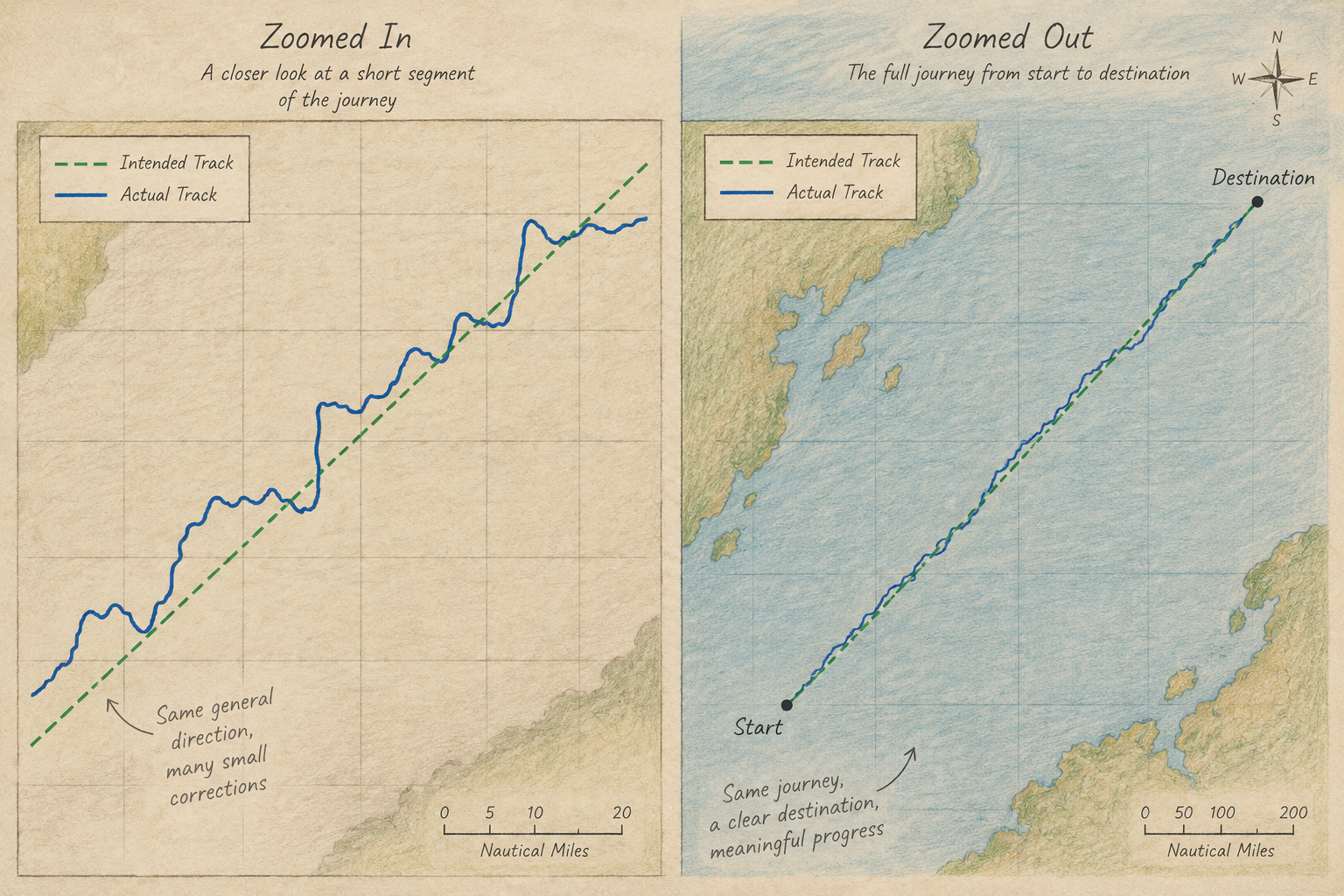
There is a reason I think the navigation analogy works so well. From far enough away, the course of a ship can appear relatively simple. There is a starting point, there is a destination, and there is a general route connecting the two. Zoom in, though, and the picture becomes much more complicated. The actual movement of a vessel is influenced by conditions, current, corrections, changing information, and the ongoing work of determining where the ship actually is compared with where it intends to go. Maritime navigation recognizes that the path actually traveled can be irregular even while the vessel continues making meaningful progress toward its destination. I think there is a powerful lesson in that for anyone responsible for hiring and developing leaders.
A Few Navigation Terms
There are a few maritime navigation terms that will help frame the discussion. I want to put them here for easy reference as we move through the article.
Destination: Where the vessel is ultimately trying to arrive.
Intended track: The path the vessel plans to follow toward that destination.
Heading: The direction the vessel is pointing at a particular moment.
Track over ground: The actual path the vessel follows. This can be irregular even when the overall journey continues in the right direction.
Set and drift: The influence of current on where the vessel actually moves compared with where it is pointed.
Fix: Determining the vessel's actual position so it can be compared with where it was expected to be.
Course correction: An adjustment made after recognizing that the vessel has moved away from the intended track.
Track made good: The overall direction of progress between where the vessel started and where it ultimately arrived.
Those concepts give us a useful way to think about leadership development because people rarely develop in perfectly straight lines either.
What Does the Course Look Like Up Close?
After graduate school, when I began a new position at an upper management level, I was new to that level of responsibility. I had education, I cared about doing good work, and I felt that I could make a meaningful contribution. I also had a lot to learn. I am grateful for my employers during that time, their willingness to take me in, the experiences I had, the people I crossed paths with, and the lessons I took from that role. All of those things were meaningful and necessary for my growth. Reflecting on my time there, I can see decisions I would make differently today. That is hindsight, though. In the moment, I was working with the knowledge, experience, and judgment I had available to me at the time. Reflection has also helped me see areas where the support and development could have been stronger for someone as new to upper management as I was.
One of those areas was destination. Looking back, I had responsibilities and problems to solve, but those things are not necessarily the same as having a clearly defined destination. A new leader can be told what is broken, what needs attention, what complaints need to stop, what processes need improvement, and which fires need to be put out, yet still have an incomplete picture of what the organization is actually trying to become. If different senior leaders have different priorities, different definitions of success, or different expectations for what the new leader should accomplish, the intended track becomes even harder to see.
That matters because development requires a destination. If we hire someone into leadership, especially someone newer to leadership, they need more than a list of problems. They need an understanding of where the organization is trying to go, what success should look like, what kind of leader the organization needs them to become, and what priorities should guide their decisions when competing demands arise. Without that clarity, we may later become frustrated that someone drifted away from a track that was never clearly established in the first place.
Once a destination has been established, another challenge appears. We have to resist judging the entire journey from too close a level of zoom.
If someone were to take individual days, weeks, decisions, conversations, and initiatives from almost any leader and plot them on a chart, the path would probably look irregular. There would be strong decisions and weak ones. There would be ideas that worked and ideas that needed to be changed. There would be moments when confidence was high and moments when uncertainty showed. Some conversations would go well. Others would become lessons for the next conversation. That is part of what leadership and development look like up close.
The danger comes when leaders begin treating every small deviation as evidence of a much larger conclusion. A poor decision becomes evidence that someone lacks judgment. An unsuccessful initiative becomes evidence that they cannot lead change. A difficult week becomes evidence that progress is not happening. Enough moments viewed in isolation can create a picture that looks much worse than the actual trajectory.
That is where the level of zoom matters.
Look at the Track Made Good
A navigator still cares about small movements. Deviations matter because small deviations can become large ones when they are ignored. At the same time, navigation also requires a broader question: Where is the vessel actually going?
The same should be true when we evaluate leaders. Where did this person begin? Where are they now? Has their judgment improved? Are they recognizing problems sooner? Are they communicating better? Are they becoming more comfortable making decisions? Are they learning from mistakes? Are they requiring the same correction repeatedly, or are earlier lessons beginning to show up in later decisions?
Those questions help reveal the leadership equivalent of track made good. Every leader, experienced or inexperienced, is going to have a messy looking path when viewed closely enough. Conditions change. New information appears. Decisions do not always produce the expected result. Sometimes a course that made sense yesterday needs to be adjusted today. That is part of leadership, life, and growth.
Experience changes how a leader responds to those moments. A seasoned leader will often recognize deviation sooner, understand what caused it more quickly, and make the necessary correction without needing much help from those above them. A newer leader may not yet have that awareness or judgment. They may need someone to help them establish where they are, recognize why they moved off course, and understand what adjustment should come next.
This is where patience becomes especially important when developing someone newer to leadership. A developing leader may have a messy looking path when viewed one decision at a time while still showing very real progress over a longer period. When an organization hires someone partly because of their potential, patience becomes part of the development process because potential still requires development.
That patience, though, has to remain connected to accountability.
Responsible leadership does not simply permit someone to wander and hope everything eventually works out. Course correction is part of navigation. If a developing leader handles something poorly, someone should help them understand what happened, what contributed to it, what they may not have seen, and what should change the next time similar conditions arise. That may mean asking how they thought a conversation went, what they were trying to accomplish, what they noticed from the response they received, what they would do differently, or what support they need before trying again.
Those conversations are part of development. The mistake becomes information. Feedback helps establish a fix. The leader gains a clearer understanding of where they are relative to where they are trying to go, and then they can make an adjustment.
Over time, those adjustments should matter. We should expect better judgment, stronger awareness, improved execution, and a greater ability to recognize when help is needed. If someone repeatedly makes the same damaging decisions, resists feedback, refuses to take ownership, or continues moving farther from the destination, then patience has crossed into something less useful. Accountability means we pay attention to whether course correction is actually producing better navigation.
Understand the Conditions
Another useful navigation principle is that the vessel's heading and its actual movement are not always exactly the same. Current and other conditions can influence where it ends up moving. Organizations have their own version of set and drift.
A developing leader may be working through unclear expectations, inherited problems, competing priorities, limited resources, strained relationships, resistant employees, conflicting direction, poor systems, or a culture that existed long before they arrived. Those conditions should not become excuses for every poor result, but they should be understood before we decide what a result says about the person.
Good development requires enough curiosity to understand both the navigator and the conditions being navigated. Sometimes a poor outcome comes from a poor decision. Sometimes the leader lacks experience. Sometimes the surrounding conditions make progress unusually difficult. Often several of those things are happening at once. The purpose of coaching, mentoring, and feedback is to help the developing leader learn to recognize those forces, account for them, and make better decisions as their experience grows.
What Did You Hire?
There is one more question I think organizations need to be willing to ask themselves: What did we actually hire?
If you hire someone with twenty years of leadership experience, you can reasonably expect something different from them than you would from someone entering their first significant leadership role. If you hire someone because you see intelligence, character, education, initiative, judgment, potential, or the ability to grow, then some of what you hired is still developing.
I think organizations can become frustrated when they hire based on potential but evaluate based on mastery.
The space between those two things is where development happens. That space may require mentoring, feedback, encouragement, difficult conversations, accountability, opportunities to try again, patience, and room for recoverable mistakes. Standards still matter. Expectations still matter. Results still matter. Growth simply requires us to understand that competence is often built through the process of applying, reflecting, correcting, and trying again.
Change the Level of Zoom
There is something interesting that happens when you look at a long voyage from far enough away. The small movements become less visible. The individual corrections begin disappearing into the larger journey. What becomes easier to see is where the vessel started, where it arrived, and the overall direction of travel between the two.
I wonder how often leaders need to change the level of zoom when evaluating the people they are developing.
There will be bad days. There will be ideas that need revision. There will be conversations that do not go as planned. There will be decisions that become lessons. There will be moments when someone needs help seeing that they have moved away from the intended track. There should also be growth. There should be learning. There should be increasing capability. There should be evidence that previous corrections are influencing future decisions.
The goal of developing leaders cannot reasonably be a perfectly straight course from the first day they step into responsibility. The goal is to help them learn how to navigate well.
Give them a destination worth moving toward. Make the intended track clear enough that they understand what they are trying to accomplish. Pay attention to the conditions they are operating in. Help them establish a fix when they lose their bearings. Offer course correction when it is needed. Hold them accountable for learning from those corrections.
Then, every once in a while, change the level of zoom.
What looks like a collection of turns, mistakes, adjustments, and lessons up close may be forming a very different picture when viewed across the full course of someone's development.